
GPT-6 Astra: What OpenAI Says About Its New AI Model

OpenAI has introduced GPT-6 Astra, a model designed for computer use, software engineering, scientific work, cybersecurity, and other professional tasks. The company says Astra combines advances in pre-training, reinforcement learning, and alignment, with a particular focus on carrying out multi-step work while staying within the boundaries set by users.
Computer use and professional work
A major focus of Astra is its ability to interact with computers and complete tasks directly. OpenAI says the model can fill out online forms, update CRM records, organize calendars, conduct online research, work in document editors, analyze scientific data, create plots, build websites, and perform frontend quality checks. It can also install and test software and troubleshoot problems displayed on screen.
OpenAI reports that on OSWorld 2.0, Astra scored 72.6%, compared with 65.7% for GPT-5.6 Sol, while taking roughly 40 minutes per task instead of 75 minutes in its latency simulation. With an updated Codex harness, OpenAI reports 1.9-times faster task completion on the Mind2Web benchmark.
The model is also intended for professional workflows involving documents, presentations, spreadsheets, and analysis. OpenAI says Astra is trained to follow existing templates and styles, select relevant context, and produce outputs suited to a user's working environment. When instructions are incomplete, it can make routine assumptions or ask questions when a decision could materially affect the result.
Coding, science, and cybersecurity
For software engineering, Astra introduces a context-management approach in Codex that preserves notes and keeps earlier context searchable when a session exceeds a context window. OpenAI says this is intended to preserve details that can otherwise be lost during repeated summarization.
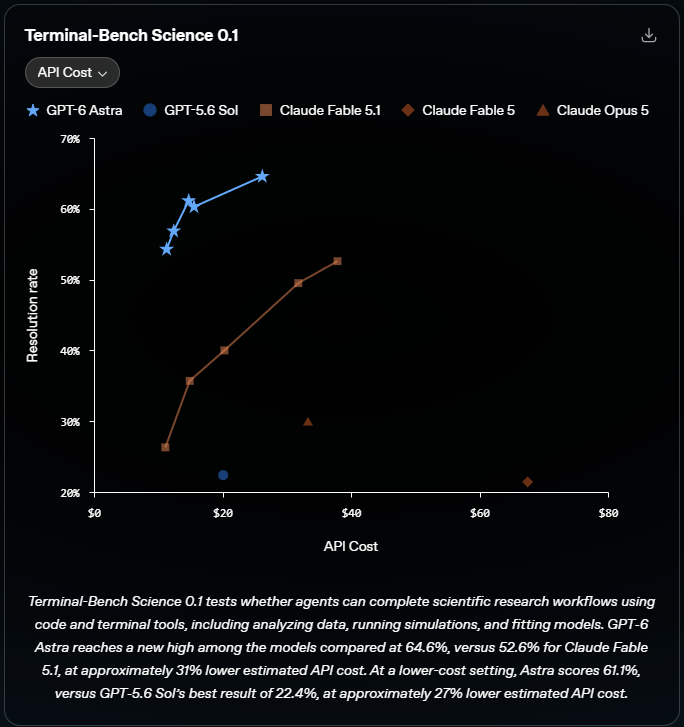
OpenAI also reports improvements in mathematics and scientific work. Astra scored 97.6% on FrontierMath Tier 4 and helped establish new results concerning both short and large gaps between prime numbers. The model can also combine scientific reasoning with computer use to inspect data in specialized software and help researchers assess results.
Cybersecurity is another area where Astra shows substantially stronger capabilities. OpenAI reports a 100% score on ExploitBench and says the model discovered two previously unknown zero-day vulnerabilities during evaluation. Because these capabilities can also create security risks, the deployed model includes safeguards and refuses some advanced cybersecurity requests.
Alignment and availability
OpenAI describes Astra as its most aligned model, reporting improvements in respecting task boundaries, avoiding unauthorized actions, and accurately communicating its capabilities. At the same time, the company says Astra's written reasoning can be harder to monitor in some evaluations and identifies monitorability as an ongoing research priority.
GPT-6 Astra is being made available through ChatGPT plans, the OpenAI API, Microsoft Azure, and Amazon Bedrock. OpenAI lists API pricing at $10 per million input tokens and $50 per million output tokens, with a separate Fast mode available at twice the standard price.
GPT-6 Astra therefore represents OpenAI's latest model focused on combining reasoning with computer interaction, professional workflows, coding, scientific research, and cybersecurity, alongside stronger safeguards for how those capabilities are used.
Sources: