
We Learn While We Sleep. AI Might Do the Same Soon.

People can continue processing and stabilizing memories during rest. A Google Research team proposes a related “sleep” framework for large language models (LLMs), designed to help them learn continuously instead of remaining fixed after deployment. The approach separates active interaction from offline processing so new information can be retained without simply overwriting older knowledge.
Deployed LLMs typically have a knowledge cutoff and do not acquire lasting capabilities from ordinary use. In-context learning can hold information temporarily, but that knowledge is tied to the context window and may be lost when the session ends. Directly updating a model’s parameters with new data creates another problem: catastrophic forgetting, in which learning new tasks damages performance on earlier ones.
The proposed framework gives the model two recurring states. During the active, or wake, phase, it receives and processes inputs, storing temporary information in fast, short-term memory components. During the sleep phase, it stops processing new inputs and uses its computation for memory consolidation and self-improvement. The model’s architecture and code remain fixed, while pre-allocated Mixture-of-Experts memory blocks are unlocked and their numerical weights are updated using self-generated practice examples.
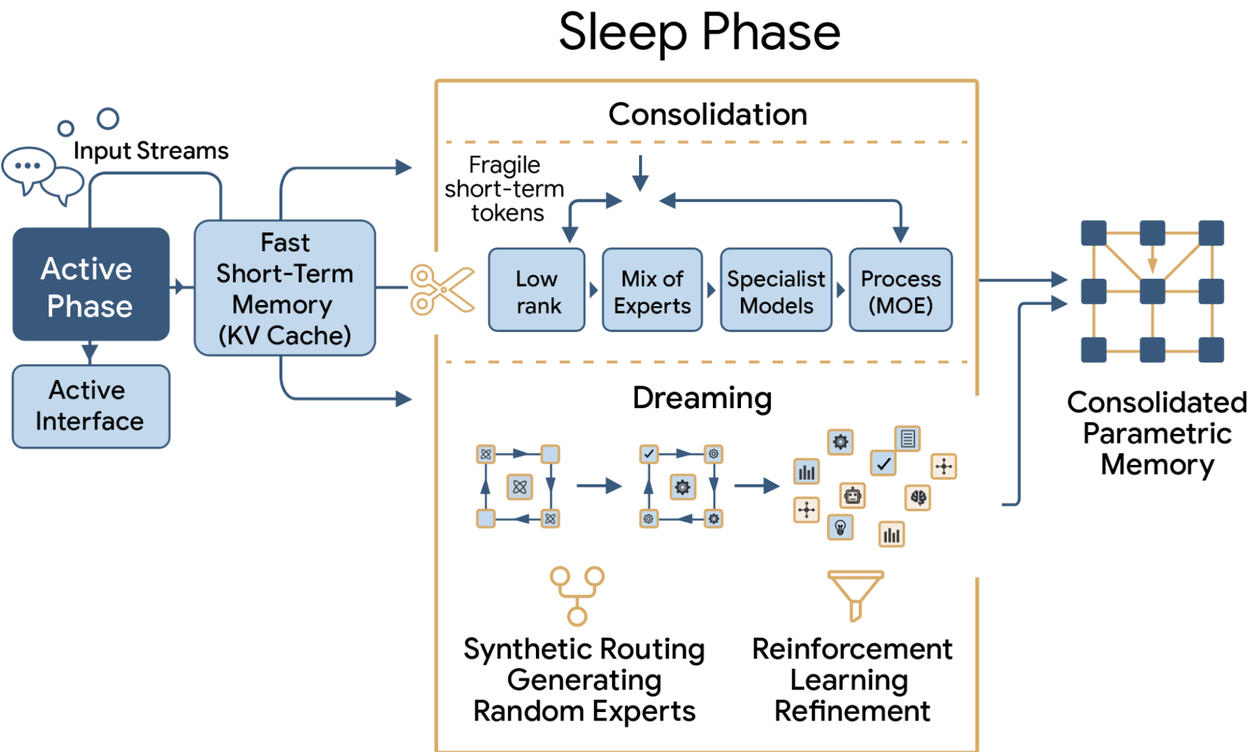
Memory consolidation transfers fragile short-term information into more stable, long-term parameters. The system expands its capacity with newly unlocked, low-rank experts so incoming knowledge can be stored without disrupting older parameters. Knowledge distillation and reinforcement-learning-based imitation help the model preserve both its own likely behavior and the semantic qualities of the information. After consolidation, temporary high-frequency parameters are reset, leaving capacity for the next active session.
A second stage, called dreaming, is intended to improve the model autonomously. The system randomly activates non-standard experts while generating synthetic examples, encouraging a wider range of learning updates. It then filters those examples according to their potential value, trains on the strongest samples, and checks whether performance improves on downstream tasks. The framework’s theory describes this as a way to diversify and select useful learning directions rather than simply adding more generated data.
In the reported evaluations, the sleep method retained performance during sequential learning in unseen-language translation and scaled long-context understanding to 10 million tokens. It also incorporated factual information without degrading existing representations and improved results on several mathematical-reasoning benchmarks compared with the listed baseline methods.
The framework therefore treats learning as a cycle of active use and offline consolidation. Its main claim is that an LLM can retain short-term knowledge, convert some of it into long-term parameters, and refine its abilities while reducing catastrophic forgetting, the same broad connection between rest and memory that motivates the term “sleep.”
Source: